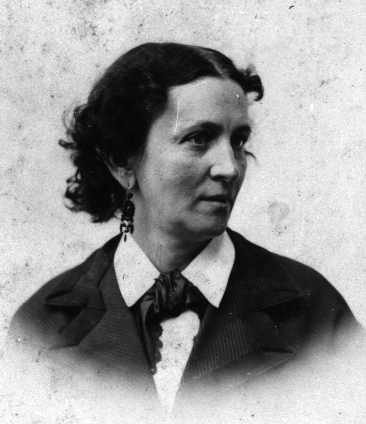
Mary Bayard Devereux Clarke (1827-1886) was a writer, poet, and magazine editor. Born in Raleigh and educated by English tutors, she began writing as a hobby, but later wrote professionally. She contributed stories, poems, and reviews to literary magazines, and she served as the associate editor of Literary Pastime, a weekly journal printed in Richmond. She was in time recognized as one of the South's leading poets.
Below is a poem titled "Lines" published by Clarke in the early 1850s about events that took place during the Revolutionary War.
Lines
Suggested by the Address of W. W. Avery, Esq., before the Two Literary Societies at Chapel Hill, 1851.
All hail to thee, thou good old State, the noblest of the band,
Who raised the flag of Liberty in this our native land!
All hail to thee! thy worthy sons were first to spurn the yoke,
The Tyrant's fetters from their hands at Mecklenburg they broke.
No coward foresight they possessed, on peril's brink to pause,
Nor waited for a sister State to lead in Freedom's cause,
"Our lives, our fortunes," was the cry, "our honors and our all,
We lay upon our country's shrine, in answer to her call."
From every heart there rose a shout, "No longer will we lie,
Submissive at the tyrant's feet, we'll conquer or we'll die:—
For freedom and our liberties we'll brave proud England's host:"—
King's Mount and Guilford prove it was no braggart's idle boast.
There England found a worthy foe her far-famed steel had met,
Firm as the rock our fathers stood, and crossed the bayonet;*
Locked in the fierce embrace of steel they bravely met their death;
Each bore his foeman to the ground, then yielded up his breath.
Ah, proudly throbs my heart to tell how nobly there they died,
A native of the Old North State, I hail with honest pride.
Nor less I glory in that band, that firm, unflinching band,
Who met in good old Mecklenburg, the chosen of the land;
With pride I number o'er the names of Polk, Brevard, and Reese,
Of Avery and of Graham,† and many more than these,
Who pledged their sacred honor, their fortunes, lives, and all,
"To spread the fire of Freedom," to conquer or to fall.
They broke the bands that bound them to the mother country's crown,
For it trampled on their freedom and strove to beat them down.
*The battle of Guilford was one of the few where bayonets were crossed.
†Signers of the Mecklenburg Declaration of Independence.
Source Citation:
Clarke, Mary Bayard. Wood-notes; or, Carolina carols: a collection of North Carolina poetry. Compiled by Tenella [pseud.] Raleigh: Pomeroy, 1854. North Carolina History and Fiction Collection, Joyner Library, East Carolina University, Greenville, NC.