By the early 1700s, the Albemarle Settlement had expanded well beyond its original boundaries. Tensions between settlers and the Tuscarora had been rising: settlers were claiming exclusive ownership of lands Tuscarora had hunted on for years while also enslaving Native people, and trade between settlers and the tribe were not always mutually advantageous. In 1710, the town of New Bern was settled along the Neuse and Trent Rivers. Attempting to avoid further conflict, the Tuscarora sought refuge in Pennsylvania to escape the harassment and enslavement by the southern settlers. Their request for asylum in Pennsylvania was ultimately refused. Below is a transcription of a report of commissioners from the Pennsylvania provincial government who met with representatives of North Carolina's Tuscarora in 1710.
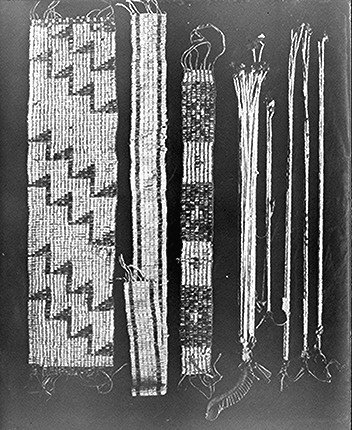
Note the use of the Wampum Belt in this source. Wampum is a string of white beads made from the shell of the North Atlantic channeled whelk, traditionally used by American Indian people of eastern North America. Belts made of wampum were given or exchanged in many different ceremonies, from marriage to treaties between peoples. Wampum could also be used for storytelling or to spell out the terms of an agreement, by using different colored beads as memory aids. In the passage, each of the first six belts is from a different group of the Tuscarora people. Note that old women come first, and then children (including those not yet born). Why do you think the Tuscarora gave these belts first, instead of starting with political leaders?
Note the language related to Pennsylvania's colonial government. The provincial government of Pennsylvania was one of the friendliest towards American Indian people, which is why the Tuscarora came to Pennsylvania instead of to another colony. William Penn, the proprietor, was a devout Quaker and a pacifist, and in addition to establishing religious freedom, he worked to ensure that American Indian people were treated fairly. He paid American Indian people fairly for their land, learned several Native languages, and guaranteed fair trials for Native people in colonial courts. Although the Tuscarora seem to have intended these belts for the Pennsylvania officials like Penn, they sent them with the Seneca delegates to the Five Nations of the Haudenosaunee Confederacy instead. After the Tuscarora War in North Carolina, the Haudenosaunee diplomats were moved by the belts and the message and invited the remaining Tuscarora to move north and become the Sixth Nation of the Haudenosaunee Confederacy.
At Conestogo, June 8th, 1710.
Present:
- John Ffrench.
- Henry Worley.
Iwaagenst Terrutawanaren, & Teonnottein, Chiefs of the Tuscaroroes, Civility, the Seneques Kings, & four Chief more of yt nacon, wth. Opessa ye Shawanois King.
The Indians were told that according to their Request we were come from the Govr. & Govmt., to hear what proposals they had to make anent a peace, according to the purport of their Embassy from their own People.
They signified to us by a Belt of Wampum, which was sent from their old Woman, that those Implored their friendship of the Christians & Indians of this Govmt., that without danger or trouble they might fetch wood & Water.
The second Belt was sent from their children born, & those yet in the womb, Requesting that Room to sport & Play without danger of Slavery, might be allowed them.
The third Belt was sent from their young men fitt to Hunt, that privilege to leave their Towns, & seek Provision for their aged, might be granted to them without fear of Death or Slavery.
The fourth was sent from the men of age, Requesting that the Wood, by a happy peace, might be as safe for them as their forts.
The fifth was sent from the whole nation, requesting peace, that thereby they might have Liberty to visit their Neighbours.
The sixth was sent from their Kings & Chiefs, Desiring a lasting peace with the Christians and Indians of this Govmt., that thereby they might be secured against those fearful apprehensions they have these several years felt.
The seventh was sent in order to intreat a Cessation from murdering & taking them, that by the allowance thereof, they may not be affraid of a mouse, or any other thing that Ruffles the Leaves.
The Eight was sent to declare, that as being hitherto Strangers to this Place, they now Came as People blind, no path nor Communicacon being betwixt us & them; but now they hope we will take them by the hand & lead them, & then they will lift up their heads in the woods without danger or fear.
These Belts (they say) are only sent as an Introduction, & in order to break off hostilities till next Spring, for then their Kings will Come & sue for the peace they so much Desire.
We acquainted them that as most of this Continent were the subjects of the Crown of Great Britain, tho' divided into several Govmts.; So it is expected their Intentions are not only peaceable towards us, but also to all the subjects of the Crown; & that if they intend to settle & live amicably here, they need not Doubt the protection of this Govmt. in such things as were honest & good, but that to Confirm the sincerity of their past Carriage towards the English, & to raise in us a good opinion of them, it would be very necessary to procure a Certificate from the Govmt. they leave, to this, of their Good behaviour, & then they might be assured of a favourable reception.
The Seneques return their hearty thanks to the Govmt. for their Trouble in sending to them, And acquainted us that by advice of a Council amongst them it was Determined to send these belts, brought by the Tuscaroroes, to the five nations.
May it please your honr.
Pursuant to your honrs. & Council's Orders, we went to Conestogo, where the forewritten Contents were by the Chiefs of the Tuscaroroes to us Deliver'd; the sincerity of their Intentions we Cannot anywise Doubt, since they are of the same race & Language with our Seneques, who have always proved trusty, & have also for these many years been neighbors to a Govmt. Jealous of Indians, And yet not Displeased with them; wishing your honr. all happiness, we remain,
Your honrs. Most humble & Obliged servants,
- JOHN FFRENCH,
- HENRY WORLEY.
|
Journey to Conestogo |
DR. |
||
|---|---|---|---|
|
To bread, |
£0 |
4 |
2 |
|
To Meat, |
0 |
4 |
0 |
|
To Rum, |
1 |
10 |
2 |
|
To Sugar, |
0 |
15 |
2 |
|
To two Men's hire for Baggage, |
4 |
0 |
0 |
|
To John, |
1 |
4 |
0 |
|
£8 |
5 |
2 |
|
Primary Source Citation:
The State of Pennsylvania. Minutes of the Provincial Council of Pennsylvania, From the Organization to the Termination of the Proprietary Government. Volume II. Philadelphia, Pa. : Jo. Severns & Company, 1852.