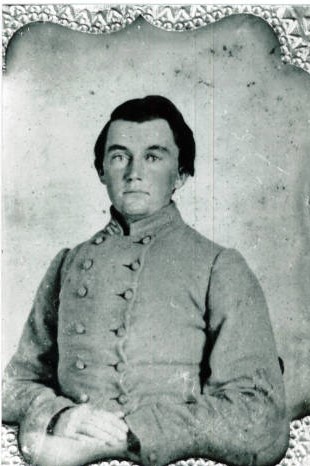
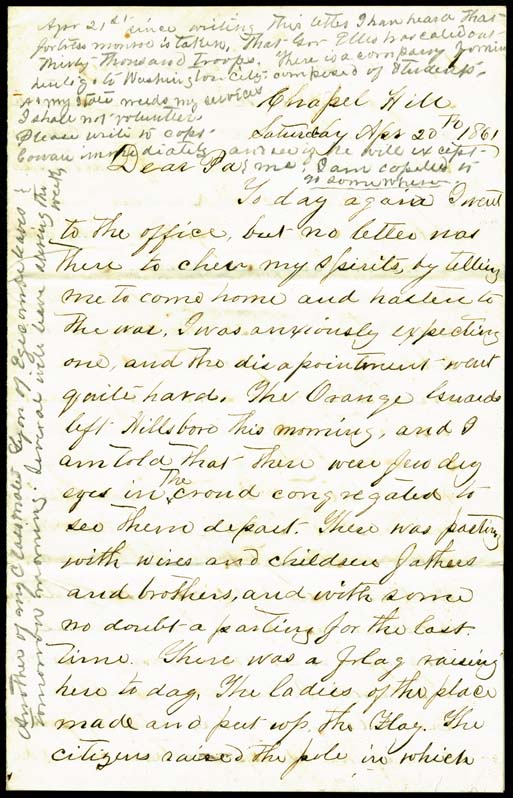
Edward Hall Armstrong began his studies at UNC Chapel Hill in 1858. By 1861, however, Armstrong felt compelled to leave his studies and enlist the Confederate army. Below is a letter that he wrote to his father, Thomas Armstrong, where he requests his father's permission to join the Confederate army.
Dear Pa
To day again I went to the office, but no letter was there to cheer my spirits, by telling me to come home and dominionhasten to the war. I was anxiously expecting one, and the disapointment went quite hard. The Orange Guards left Hillsboro this morning, and I am told that there were few dry eyes in the crowd congregated to see them depart. There was parting with wives and children fathers and brothers, and with some no doubt a parting for the last time. There was a flag raising here to day. The ladies of the place made and put up the Flag. The citizens raised the pole in which I had the pleasure of assisting. Two young ladies made speaches and were followed by the following noted gentlemen, S. F. Phillipps, Capt Ashe, Gov Swain and Sidney Smith, together with quite a number of Students. Gov Swain in alluding to the war said that the south was invincible by any force that our enemies can send against us. He thought that further blood shed could be avoided, by every man in the South shouldering his musket. Lincoln would then see our strength and would know that it would be useless to attempt to coerce us. Such being the case I beg you to let me be one to proceed to Federal Point, and frighten Lincoln out of his witts, if possible and if the Gov's prediction should prove untrue and war should actually be necessary, I should be happy to bear a part, humble though it be, in defense of my country. The flag raised to day contained nine stars, the last two in honor of Virginia and N. C. This is probably the first flag raised, on which N Carolina has been numbered with the seceeding states. God grant that she may soon take her place among her southern sisters in reality. News from Maryland states that, the citizens of Baltimore yesterday attacked the Seventh regiment of N. Y. which was proceeding to Washington in answer to Lincoln's call. reports says that about 14 were killed.
Thank the lord that Maryland has yet some patriots left within her borders, who will oppose aggression to the death, although she is presided ofer by the traiterous Hicks. I learn even while writing that Lincoln has taken Genl Scott prisoner because he was going to side with the south, and had thrown up his commission, and has him now in Prison. This is fine treatment to give that old veteran who has fought and bled in defence of his country. There was also a skirmish yesterday at Harpers Ferry. Major Lilly of Virginia who lives near there is here now on his way to take charge of his company. Two Thousand South Carolineans are now on their way to Norfolk to aid the virginians in taking Fort Monroe. Can I stay here and pretend to study, when I am continually hearing news from the war and when my country needs? Apr 21st since writing this letter I have heard that fortress monroe is taken, that Gov Ellis has caled out thirty thousand troops. There is a company formin[g] here to go to Washington City, composed of students. As my state needs my services I shall not volunteer. Please write to Capt Cowan immediately and see if he will except me. I am copelled to go somewhere. Another of my classmates Lyon of Edgecombe leaves tomorrow morning. Several will leave during the week.
Primary Source Citation:
Edward H. Armstrong to Thomas G. Armstrong, April 20, 1861. Published online by Documenting the American South. University Library, The University of North Carolina at Chapel Hill. https://docsouth.unc.edu/true/mss06-07/mss06-07.html